News

What Cancer Cells Love Better Than Anything

Cancer cells love to thrive in an anaerobic environment – that means “without oxygen”.  They love conditions where tissues are acidic and oxygen levels are low.

That’s one of the first things I learned about cancer – something called The Warburg Effect.

The Warburg Effect and Why You Should Care

In 1931 Otto Heinrich Warburg was awarded the Nobel prize in Physiology and Medicine, mainly for his investigation of the metabolism of tumors and the respiration of cells, and more particularly, for his discovery of respiratory enzymes. He edited and has much of his original work published in “The Metabolism of Tumours” (1931) and wrote “New Methods of Cell Physiology” (1962).

Otto Warburg observed that the metabolism of cancer cells is different than for normal adult cells. Normal adult cells use a small energy plant located inside them to produce most of their energy needs from oxygen, termed an “aerobic” process. In contrast, cancer cells rely mainly on glucose (sugar) for the first part of their energy production, termed an “anaerobic” process. The anaerobic process is called glycolysis.
Remember that one of my first few newsletters talked about how sugar is a problem for cancer patients?

The paradox is that cancer cells rely on glucose even if oxygen is available. This phenomenon is called aerobic glycolysis or the Warburg effect.

The other thing that cancer cells love is an acidic environment – they clump together in this environment and steal sugar from the body of their host. It stands to reason that if cells are all stacked up and sticking together, their ability to behave normally is impaired and trouble ensues!

So How Do We Combat The Warburg Effect?

When someone is first diagnosed with breast cancer, what becomes more important than anything is to find out what could interrupt this process of a lack of oxygen and acidity in the body’s tissues.  This is a crucial part of the puzzle to help establish the Root Cause:

1.  Get sugar out of your diet.   Because we, as normal human beings, tend to love sugar so much, and because it seems to be in so many things we eat, it can be very hard to avoid. Educate yourself around food and hidden sugars.

My best recommendation about sugar is this.  If you believe that you could have some cancer cells racing around inside your body still, avoid sugar like the plague, especially refined sugar. Sugar from fruit (fructose) should be limited, but it is important to understand that fruit is very beneficial for fighting breast cancer. On the other hand, if your doctor has said you are cancer-free (or if you never had it and just want to keep it that way), limit your sugar intake severely. It has been said that sugar is 8 times more addictive than cocaine and it is so hard on all of the systems of your body.  

2. Juicing.  Juicing organic vegetables (especially beets and greens) and fruit offers the best form of nutrition for your body, most easily and quickly bio-available and helps to get your system alkaline very quickly. It also helps to bring more oxygen to your cells. Use a masticating juicer, it’s the very best kind for healthy juicing. 

3. Eat lots of organic raw foods to help your body be as alkaline as it can be, and to provide your cells with the building blocks they need, and the anti-cancer phytochemicals that are in raw food. I don’t mean that you have to eat raw food all of the time, but at least once per day is a good thing to aim for.

4. Start on a fitness regimen to keep your cells oxygenated – swimming, walking, yoga, tai chi, cycling, gym workouts, yoga – they all help immensely. Studies show that at least 30 minutes of exercise per day goes a long way toward helping breast cancer survivors stay fit and well.
 5. Essential oils bring more oxygen into the body. You can diffuse them, breathe them in from the bottle or your hands, spread them on your body via a carrier oil or your own organic lotion. Use them daily!

6. Know which supplements make a huge difference for healing from breast cancer.  Start by getting a HTMA and the recommended Blood Panel, we can establish what minerals are deficient in your body due to the stress you have endured. Also we will be able to assess from these tests how your body is responding to blood sugar, and take a look at thyroid and adrenal health, liver & gut function etc…..

Contact the clinic for more information or to make an appointment.

With regard to Breast Cancer : Prevention should take precedence over detection

Of course everyone has heard by now that early detection prolongs life expectancy, this is a given. However if cancer has been detected early, it would mean that you already have cancer. Prevention should take precedence over detection. Prevention means not getting cancer in the first place. If we are going to reverse the present trend of the epidemic proportion of breast cancer, we need to come up with a more proactive approach, which needs to become the norm for patient assessment. Cancer starts with one abnormal cell, and it takes nearly 8 years for that one abnormal cell to replicate to one billion cells. One billion cells produce a detectable lump that is one centimeter in size. This is the size of a lump that can be seen on a mammogram. This is not an early finding.

Every woman should know her risk for breast cancer. With proper risk assessment that includes different testing modalities, the patient is able to determine her risk factors and develop an action plan on how to improve the breast tissue or even reverse the existing trend. The current screening strategy is not enough to protect women from breast cancer. Breast Thermography also known as Medical infrared imaging should be added to every woman’s regular breast health care. Stay informed and make the best choices for your Breast Health.

Breast Health Program

True preventative breast health based on scientific testing and personalised nutrition.

Breast Thermography is available in our clinic in Dublin, Ireland or Zoom consultation world-wide.

Breast health issues are plaguing many women today: from heavy, swollen painful breasts before a period to diagnosed fibrocystic breasts to breast cancer – our breasts are a very sensitive barometer of our health.

Looking at your breast health in a preventative manner and addressing issues that are already there is vital in today’s environment. In order to resolve our breast issues we need to address hormonal, gut and detox problems.

Many of my clients have the breast related symptoms, fibrocystic breasts, tenderness, swollen &/or painful breast etc…and are told such things as ‘it is just benign and needs to be checked by an ultrasound now and then’. Painful and heavy breasts before periods – ‘just part of being female’.

None of these issues are normal. They are very common but not normal. They all occur due to gut problems such as low stomach acid (nutrients not broken down), leaky gut (nutrients not absorbed), gut imbalances (the wrong bacteria sending estrogen back into re-circulation) as well as liver issues (not detoxing environmental pollutants and not breaking down hormones efficiently) as well as certain genetics.

Add to this adrenal fatigue (doing too much, stressing too much, caring too much for others and not self) which eventually affects thyroid function negatively and you have a perfect storm for breast and other health issues.

breast health sydney nutritionist

The Key Organ systems involved in breast health are:

  • the stomach and small intestine: they facilitate absorption of vital nutrients for breast health
  • the liver- toxin and hormone elimination is paramount for breast health
  • the colon – imbalanced gut bacteria lead to excess estrogen hormones accumulating

It is important to balance hormones for breast health. These are:

  • estrogen
  • progesterone
  • cortisol – stress ‘steals’ our balancing hormones like progesterone
  • insulin

Without achieving hormonal balance, improving gut health, proper elimination and detoxification we cannot have healthy breasts.

This program is for you if:

  • you suffer from painful, swollen and enlarged breasts at any stage in your cycle
  • you have been diagnosed with fibrocystic breasts
  • you have been diagnosed with breast cancer
  • a member of your immediate or extended family has had breast or prostate cancer and you would like to invest in your health in a preventative way

The number 1 cause of hormonal imbalance is STRESS!!


Stress affects a woman’s endocrine system instantly. It is an evolutionary quirk related to times of famine and limited food sources.

A woman’s fertility is reduced as soon as the body is placed into a state of long-term stress. Literally, your sex hormones are turned off in order for your stress hormones to activate.

So with this in mind, it makes complete sense to focus on managing stress as a core component of your approach to hormonal balance.

Stress is one of the most significant contributing factors towards developing a hormonal imbalance.

The entire glandular system is interconnected, so when one gland is overstimulated, such as the adrenals in stress, then there are consequences in other glandular outputs.

During times of stress, the adrenals produce more cortisol, and since the body is now essentially in fight-or-flight mode, it starts to reduce sex hormone production.

This is a natural survival response. In hard times, the body inhibits sex hormones to reduce the fertility rates; and then in good times, hormones balance and fertility levels increase.

If you ever wondered why infertility rates are so high, persistent levels of stress is one of the main reasons.

What is cortisol?  

In its normal function, cortisol helps us meet life’s challenges by converting proteins into energy, releasing glycogen and counteracting inflammation.

For a short time, that’s okay. But at sustained high levels, cortisol gradually tears your body down. 

Cortisol is one essential we can’t live without. But too much of a good thing is not healthy.

Apart from causing hormonal imbalance, sustained high levels of cortisol destroys healthy muscle and bone; slows down healing and normal cell regeneration; co-opts biochemicals needed to make other vital hormones; impairs digestion, metabolism and mental function; interferes with healthy endocrine function, and weakens your immune system.

After a period of time, the adrenals eventually become fatigued, which may be a factor in many related conditions – including fibromyalgia, hypothyroidism, chronic fatigue syndrome, arthritis, premature menopause and others. It may also produce a host of other unpleasant symptoms, from acne to hair loss.

HHY - Hormonal Stress Effects

For menopausal women, this is a particular problem – because during and after menopause, the adrenals need to produce small amounts of oestrogen – so when they are depleted, it leads to more extreme menopausal symptoms.

Women today are doing too much. Women’s bodies were not designed for long-term stress levels, and the result is imbalanced hormones.

Unfortunately, we often cannot change our life circumstances; however, there is one thing that you can do. MEDITATE.

Research has shown conclusively that meditation helps to reduce stress hormones and increases a beneficial hormone called DHEA, which is the building block for hormone production and a natural anti-ageing hormone.

So what is the best type of meditation?

Well, it all depends on the individual, but a form of meditation that stills the mind, stills the body, and leaves you with a sense of balance and calm.

Yoga and meditation together are particularly beneficial. We have created this simple guided meditation to help you start the process.

Guided meditation or relaxation is perfect for beginners and keeps your mind focused. Find a quiet place and put on some headphones and see how you feel after the relaxation. Take a look at a post l prepared with a selection of short meditations to get you started.

Estrogen Dominance & Thermography

What Your Breasts are Trying to Tell You

Lifetime exposure to estrogen has been identified as a significant risk factor for the development of cancer.

More and more today, women and their health care providers are choosing to monitor hormonal levels. When we measure the level of estrogen and progesterone in the blood, urine, or saliva we are looking at the hormonal balance in the whole body.  These are all useful tools providing useful information.

But the question remains… what is the effect of these hormone levels on the breasts?

The breasts have their own estrogen story.

Serum levels of hormones may not actually match the tissue levels.  Breast tissue can have up to 50 times the estrogen concentration as serum.  Normal fatty tissue in the breasts can actually produce estrogen which will be missed on blood testing and can contribute to risk. Some women have estrogen receptors that are more sensitive or bind estrogen more easily. They may even test as low estrogen levels but their breasts are actually being over-stimulated by the estrogen they do have.

Salivary tests have been used to assess tissue hormone levels but don’t take into account that the breasts produce estrogen locally while salivary gland tissue does not.

Lab test such as these are still very helpful in determining a therapeutic intervention and monitoring its effects and should not be discontinued.

Thermography can offer your physician a powerful tool ….one that can help identify Breast Specific Estrogen Dominance.

This is done with thermography by identifying the vascular development in your breasts.

Thermography imaging is a way to look at the effects of estrogen on the breasts. Identifying the vascular development in your breasts can be critical in establishing your risk for breast disease.

Being proactive.

If a woman has a higher than expected stimulation of the breast tissue, she can work with a qualified health provider to determine if excess estrogen is suspected. Once intervention is put into motion, the effectiveness of this action can be then monitored by a later thermogram.  Basically, a window into seeing if what you did actually worked.

By using thermography to see the level of estrogen in your breasts, you have a tool that compares and contrasts to other tools.

Studies have shown that high levels of estrogen are a key risk factor for breast disease. 

Thermography is a direct measure of breast physiology & is helpful as both a detection and monitoring tool.

Listen to your body.

Five exercises to strengthen immunity and flush your lymph system during flu season

How simple home exercises, including neck rolls and yoga poses – collectively known as ‘intelligent movement’ – can boost the immune system

Heather Thomas Shalabi

Heather Thomas Shalabi

Heather Thomas Shalabi, managing director of Flex Studio in Wong Chuk Hang, performs kapalbhati breathing exercises. Photos: May Tse

Heather Thomas Shalabi, managing director of Flex Studio in Wong Chuk Hang, performs kapalbhati breathing exercises. Photos: May Tse

It’s no secret that exercise is important for overall health and wellness. But exactly how movement keeps the doctor away can often be overshadowed by its aesthetic benefits.

To gain insight into how intelligent movement helps us live well for longer, we need to take a look into the workings of one of the body’s major networks: the lymphatic system.

Why? Because moving in general stimulates the flow of lymph fluid, giving a tremendous boost to the immune system.

Our lymphatic system is a network, consisting of lymphatic vessels and nodes that remove waste from the body. Lymph fluid (a form of blood plasma) collects this waste from cells and transports it. Two other functions of the lymphatic system are to maintain fluid balance in tissues and organs and for the absorption of fats and fat-soluble nutrients.

Inactivity can significantly restrict lymph flow, and lead to a build-up of waste and toxins believed to play a role in inflammation and disease.

How exercise helps us manage this is simple: through muscle contractions and manual manipulation, lymph manages to isolate and eliminate infection and cellular waste. Deep breathing, exercise and massage, therefore, are great ways to encourage lymph flow and to maintain the health of this essential system. The movement created by combining deep breathing with stretching, such as yoga, has proved to enhance lymph circulation. Many experts also claim that jumping on a trampoline is the perfect exercise for restoration and maintenance of the lymphatic system, as it stimulates the rebound of lymph fluid with low-impact, repetitive action.

To better understand the lymphatic system, we need to look at its finer workings. The system consists of organs – lymph nodes – a fluid called lymph and transportation vessels. It is similar in many ways to the blood circulatory system, in that it is an extensive network of vessels that traverse almost all our tissues, allowing for movement of lymph fluid.

This fluid drains through lymphatic vessels in a way that is very similar to blood returning through veins to the heart. Unlike the circulatory system, however, lymph has no direct propulsion of its own. Lymphatic fluid moves through the vessels by being squeezed when we consciously use skeletal muscles or move smooth muscles through breathing or other involuntary actions. The efferent – or “outward moving” – lymph vessel walls and valves also facilitate the movement of lymph once the nodes have filled with fluid, and prevent lymph from travelling backward.

Luckily, there are simple exercises you can do each day to stimulate lymph flow and hopefully stave off illness:

Neck roll.

Neck roll.

Neck rolls: stand or sit tall with arms by your sides. Gently bend your head left, chin tilted down, shoulders relaxed. Slowly roll your head clockwise; complete a full circle. Repeat as desired, changing direction halfway.

Pelvic tilts: lie flat on your back, feet hip width apart, knees bent. Flatten lower back against the floor and tilt spine upwards – abdominals are in a C-curve. Lower and repeat several times.

Single leg circles.

Single leg circles.

Single leg circles: Lie on your back with legs straight. Raise right leg high and straight as possible. Ensure abdominals are engaged and lower back pressed firmly into the floor. Make several small, clockwise circles in the air with toes pointed. Repeat in reverse direction and then with other leg.

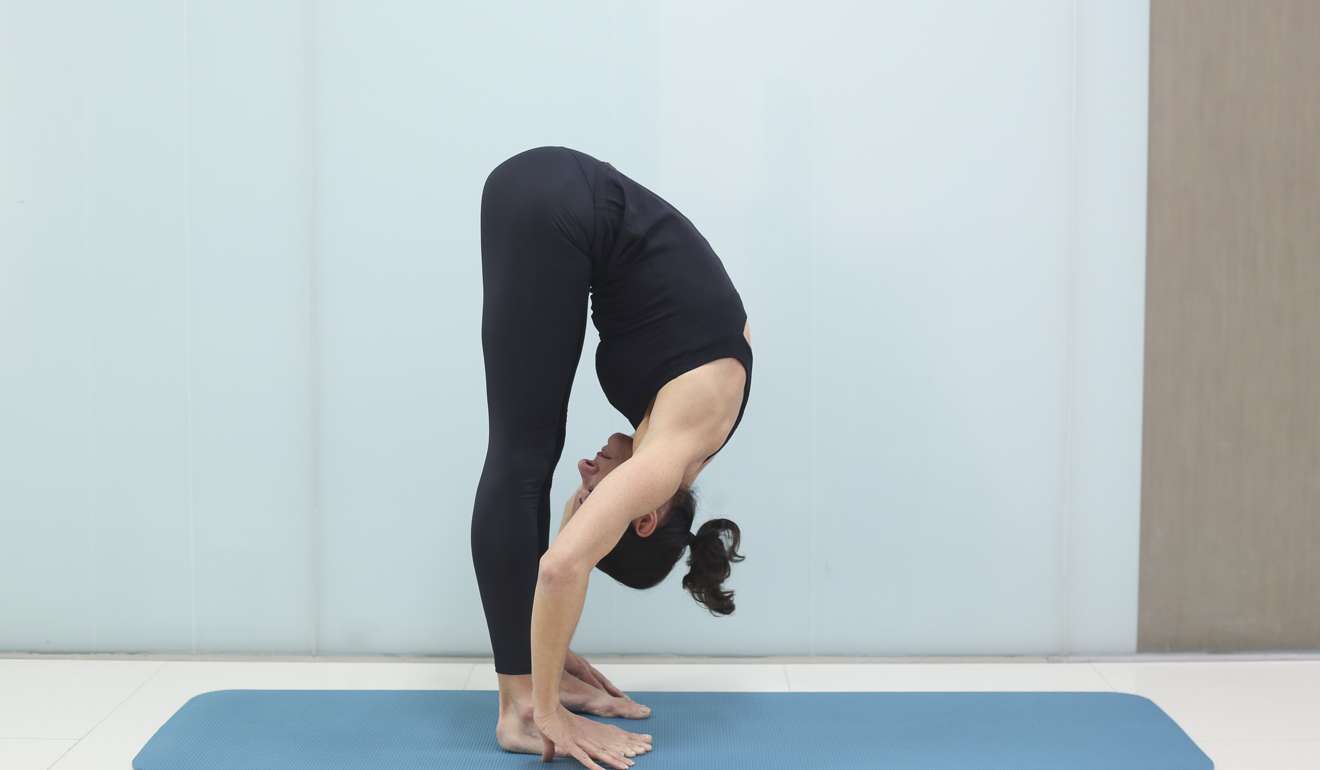
Forward bend (uttanasana).

Forward bend (uttanasana).

Forward bend (uttanasana): Stand straight, arms by your side, feet close together. Raise arms to the side and slowly bend forward and down, from the hip. Bend knees if you can’t touch the floor with straight legs. Nod your head yes and no. Breathe. With abdominals engaged, slowly and mindfully rise to standing.

Cleansing breath (kapalbhati breath): Sit tall in a comfortable cross-legged position, forcefully exhale repeatedly through the nose (strongly contracting the stomach) and keep a steady pace. The ideal number of rounds is 500 exhales (per day) but start with increments of 100.

Lifting kettlebells.

Lifting kettlebells.

Lifting kettlebells: Holding a kettlebell in both hands, squat with legs wide and with back as straight as possible. Hold for several seconds, slowly stand to straighten, lifting the kettlebell to shoulder height or higher. Repeat several sets.

Find your lymph nodes: The major node clusters are in six areas, concentrated in rotational joints or the thoracic area, where involuntary breathing movement occurs. In the case of an infection, nodes swell – so-called swollen glands – due to a build-up of lymph fluid, bacteria or other organisms.

• Cervical region: nodes are along the lower border of the jaw, in front of and behind the ears and deep in the neck along larger blood vessels, draining skin on the scalp, face, tissues of the nasal cavity and pharynx.

• Axillary region: under the arms, near the surface of the skin and deeper in the chest tissue. They receive lymph from vessels that drain the arm, walls of the thorax, breast and upper walls of the abdomen.

•Inguinal region: nodes here receive lymph from the legs, the outer portion of the genitalia and lower abdominal wall.

• Pelvic cavity: mostly along the paths of blood vessels within the pelvic cavity and receive lymph from lymphatic vessels in the area.

• Abdominal cavity: nodes occur in chains along the main branches of the arteries of the intestine and abdominal aorta.

• Thoracic cavity: between the lungs and along the windpipe and bronchi.

Extra tips

• Drink six to eight glasses of purified or filtered water per day. Hydration helps maintain proper lymph fluid levels.

• A weekly sauna or steam bath can help remove waste through pores, lessening the load on the lymph system.

error: Content is protected !!